Metallodrugs
Functionalized Organometallic Ruthenium Scaffolds
The development of ruthenium-based anticancer drugs represents one of the most prominent areas in metallopharmaceuticals for chemotherapy. The main motivation for using ruthenium is its lower toxicity, in comparison to platinum, and the ease of accessing ruthenium compounds given its rich coordination and redox chemistry. Recently, two ruthenium(III)-based compounds, namely KP1019 and NAMI-A, successfully completed Phase 1 clinical trials and are scheduled to enter Phase 2 trials in the near future. In particular, KP1019 is transported by serum protein transferrin into cells, where it is reduced to Ru(II) species and induces oxidative DNA damage resulting in apoptosis.
Another class of ruthenium complexes that have been actively pursued as anticancer agents contains the organometallic [(η6-arene)Ru] fragment. From a structural perspective, the organometallic ruthenium scaffold is particularly intriguing because it resembles a "piano-stool". By altering either "stool-top" or the "stool-legs", a range of structurally-diverse complexes can be easily prepared as targeted chemotherapeutic agents. Using this strategy, a wide variety of organometallic ruthenium complexes have investigated as anticancer drug candidates and some were found to exhibit favourable pharmacological and cytotoxic profiles for further development.
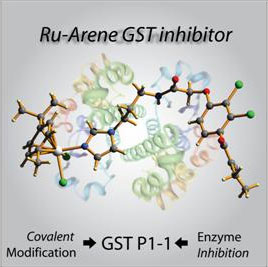
Organometallic ruthenium-based enzyme inhibitor
Inside

Loading content... Please wait a moment.

Explore
About
Resources
Quick Access
Site (v3.0) designed by Nicholas Ang.
Copyright © Dr. Ang Wee Han 2010.